
Space Events
Total Solar Eclipse 2027: Date, Path, Duration and Viewing Guide
Discover the August 2, 2027 total solar eclipse, including its path of totality, expected duration, visibility, viewing locations and essential eye safety guidance.
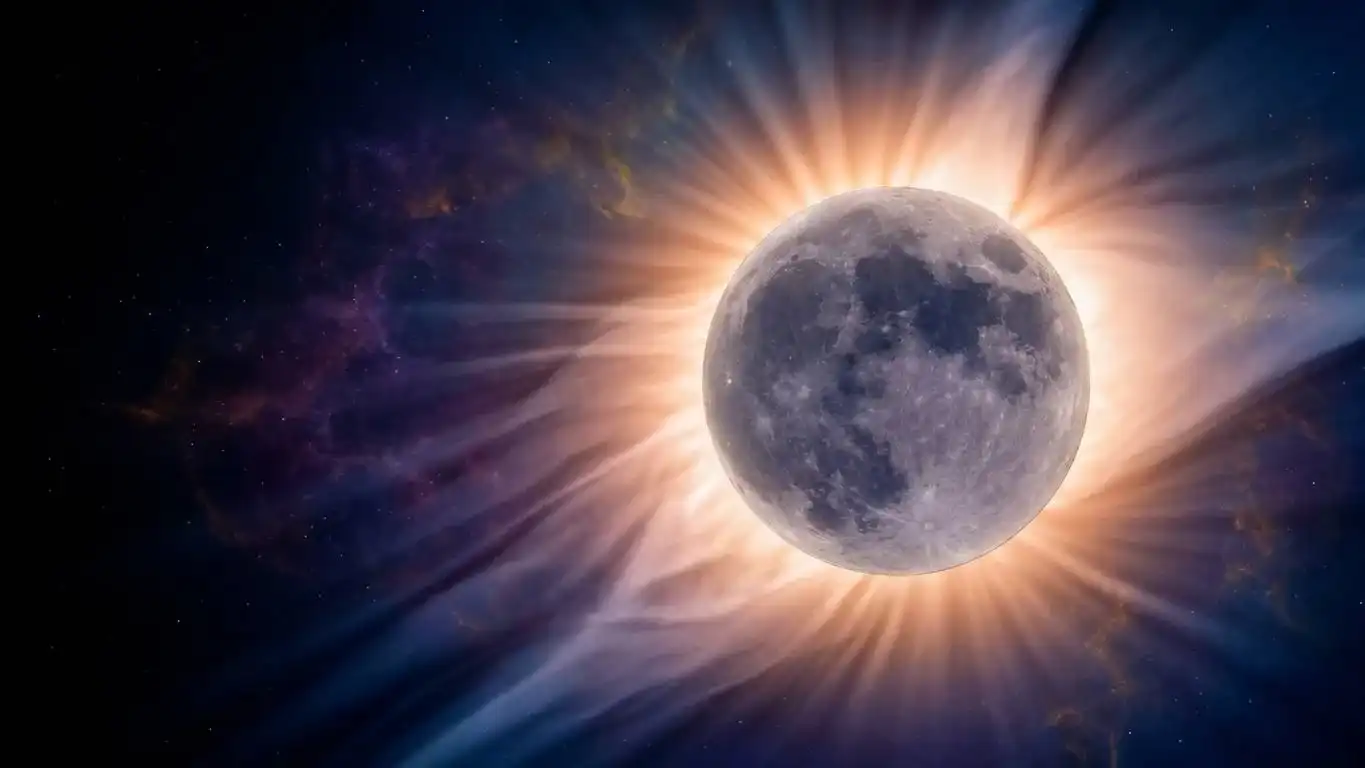
One of the most anticipated astronomical events of 2027 will take place on August 2, when the Moon passes directly between Earth and the Sun, producing a total solar eclipse along a narrow path across parts of the world. During totality, the Moon completely covers the Sun's bright photosphere, revealing the much fainter solar corona. This spectacular alignment will create an opportunity for millions of people to experience one of nature's most remarkable astronomical events. The exact appearance and duration will depend on the observer's location.
When Will the 2027 Total Solar Eclipse Happen?
The total solar eclipse will occur on August 2, 2027. It will happen when the Moon moves into alignment between Earth and the Sun during the new moon phase. The event will progress across different geographical regions as Earth's rotation and the Moon's orbital motion change the position of the lunar shadow. The beginning, maximum and ending times will therefore vary according to location. Anyone planning to observe the eclipse should use a detailed astronomical eclipse map to find the local circumstances, including the start of the partial phase and the timing of totality.
Where Will the Eclipse Be Visible?
The path of totality will cross parts of southern Europe, North Africa and the Middle East. Countries and regions along the path include parts of Spain, Morocco, Algeria, Tunisia, Libya, Egypt, Saudi Arabia and Yemen. Observers inside this relatively narrow path will experience a brief period when the Moon completely covers the Sun's bright disk. People outside the path may still see a partial eclipse, but they will not experience totality. The exact viewing conditions depend on the observer's distance from the centre line, geographical position and local horizon.
How Long Will the 2027 Eclipse Last?
The duration of a total solar eclipse is not the same everywhere along its path. Observers near the central line generally experience a longer period of totality than those closer to the edges. The duration is influenced by the apparent sizes and relative positions of the Sun and Moon, as well as the geometry of the lunar shadow. Some locations along the 2027 path are expected to experience more than six minutes of totality, making this an especially notable event. For accurate local timings and duration estimates, observers should consult detailed eclipse predictions rather than relying on a single global time.
How Does a Total Solar Eclipse Happen?
A solar eclipse occurs when the Moon passes between Earth and the Sun and blocks some or all of the sunlight reaching an observer. Although the Sun is much larger than the Moon, it is also much farther away. This distance difference allows the two objects to appear approximately the same size in Earth's sky. When their alignment is sufficiently precise, the Moon can completely cover the bright solar disk for observers inside the path of totality. The Moon's shadow creates two important regions: the darker umbra, where totality is visible, and the lighter penumbra, where observers experience a partial eclipse.
What Can You See During Totality?
During totality, the bright photosphere disappears behind the Moon, allowing the solar corona to become visible as a faint outer atmosphere surrounding the dark lunar disk. Depending on atmospheric conditions and the stage of the eclipse, observers may also notice changes in the surrounding landscape, unusual lighting and the appearance of bright stars or planets. The experience is very different from an ordinary partial eclipse because the complete disappearance of the Sun's bright surface creates a brief period of darkness. These features make totality particularly valuable for astronomical observation and photography.
How to Watch the Eclipse Safely
Looking directly at the Sun without suitable protection can cause serious and permanent eye damage. During all partial phases of a solar eclipse, observers must use certified solar viewers that meet the applicable ISO 12312-2 standard or use an appropriate indirect projection method. Ordinary sunglasses, even very dark ones, are not safe substitutes. Cameras, binoculars and telescopes require properly fitted solar filters designed for the front of the instrument. During the brief period of totality, direct viewing without a solar filter is safe only while the Moon completely covers the Sun's bright photosphere. Observers must put their solar protection back on immediately when any bright part of the Sun reappears.
How to Choose a Viewing Location
Choosing a good location requires more than finding a place inside the path of totality. Observers should consider local weather patterns, cloud cover, accessibility, transport and the position of the Sun during the eclipse. A location with an unobstructed view of the sky can make the experience easier to enjoy. Travellers should also check local regulations, accommodation availability and transport arrangements well before the event. Weather forecasts become more useful closer to August 2, 2027, so flexible travel plans may help observers respond to changing conditions.
Why Is the 2027 Eclipse Special?
The August 2027 eclipse is notable for its long predicted duration of totality in parts of its path. A longer period of darkness provides additional opportunities to observe the solar corona, study the surrounding environment and photograph different stages of the event. It is also expected to attract astronomy enthusiasts and visitors to regions where totality can be experienced. For scientists, eclipse observations can contribute to research into the solar atmosphere and the interaction between sunlight and Earth's environment. For the public, it offers a rare opportunity to experience a complete solar eclipse without specialist astronomical equipment beyond essential eye protection.