
Space Technology
How Rocket Engines Work: The Technology Behind Space Launches
Discover how rocket engines generate thrust, how liquid and solid propellants differ, and why rockets can operate in the vacuum of space.
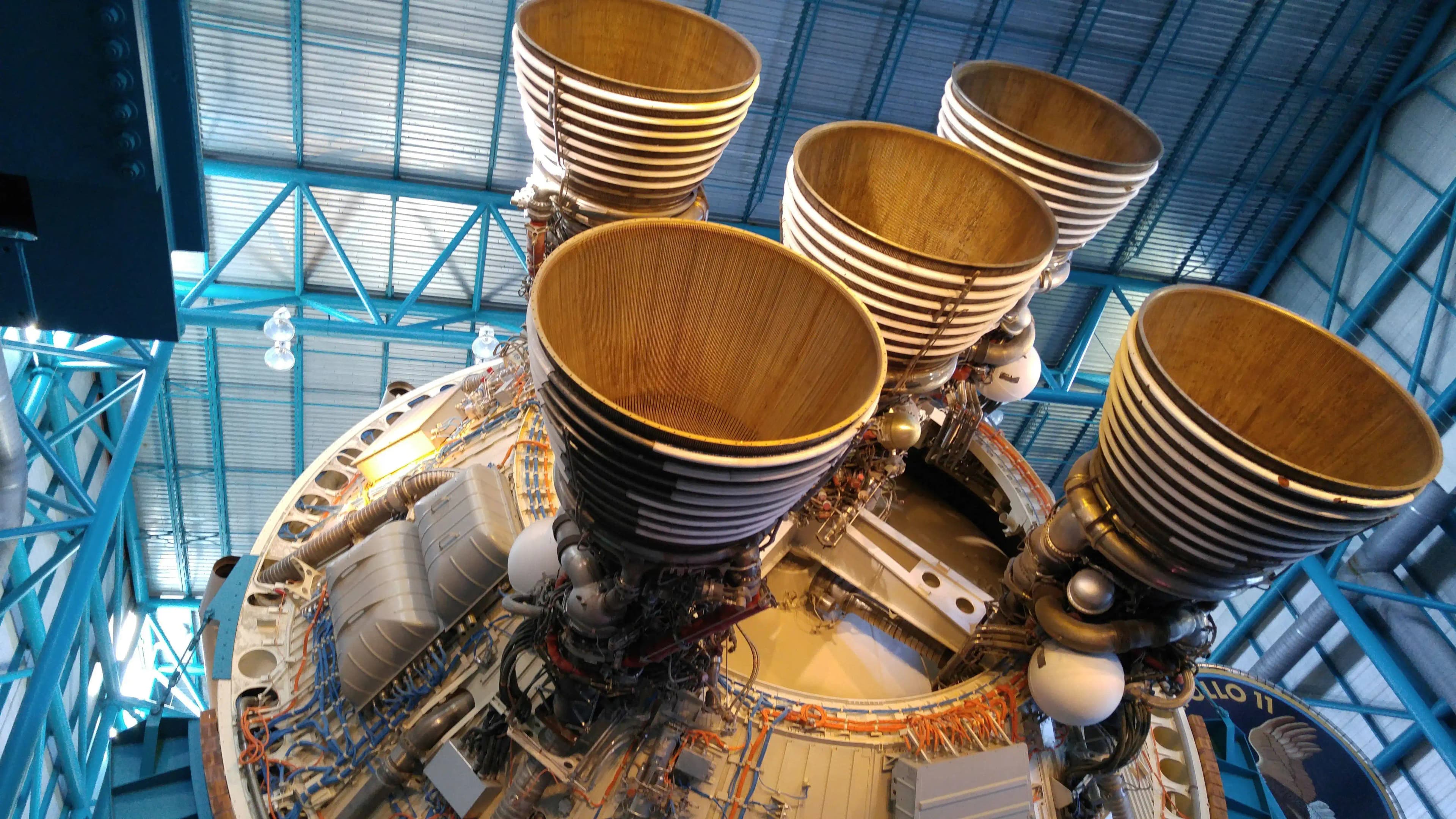
Rocket engines are among the most powerful and technically demanding machines developed by engineers. They provide the force needed to lift launch vehicles away from Earth, accelerate spacecraft and place satellites into orbit. Although rockets come in many shapes and sizes, they all rely on a basic principle: expelling mass in one direction produces a force in the opposite direction.
How Does a Rocket Engine Produce Thrust?
A rocket engine generates thrust by accelerating exhaust gases out of a nozzle. In a typical chemical rocket, fuel and an oxidizer react inside a combustion chamber, producing extremely hot, high-pressure gas. The nozzle directs and accelerates this gas out of the engine, producing a force that pushes the rocket in the opposite direction.
This behaviour is described by Newton's third law of motion: an action produces an equal and opposite reaction. The engine pushes exhaust backwards, while the rocket experiences thrust forwards. The amount of thrust depends on factors such as the mass flow rate of the exhaust, its exit velocity and the pressure conditions at the nozzle.
Why Do Rockets Work in Space?
Unlike an aircraft jet engine, a rocket does not need to draw oxygen from the surrounding atmosphere. It carries both the fuel and the oxidizer required for combustion. This allows it to generate thrust in the vacuum of space, where there is no atmospheric oxygen for an ordinary jet engine to use.
A rocket also does not push against the air or need something behind it to move forward. Its motion comes from the momentum carried away by its exhaust gases. This is why the same basic propulsion principle works during launch through the atmosphere and later in the vacuum of space.
Liquid Rocket Engines
Liquid rocket engines store fuel and oxidizer in separate tanks. Pumps or pressurization systems feed the propellants into a combustion chamber, where they mix and react. The resulting hot gases pass through a nozzle to produce thrust.
Liquid engines can offer precise control because propellant flow can be regulated and, in many designs, stopped and restarted. However, they require complex tanks, valves, pumps, cooling systems and plumbing. Their performance and reliability depend on the careful design of all these components.
Solid Rocket Motors
Solid rocket motors contain fuel and oxidizer mixed together in a solid propellant grain. Once ignited, the propellant burns and produces hot gases that escape through a nozzle. Solid motors have relatively simple designs and can be stored for extended periods, making them useful for certain launch vehicle applications.
A major difference is that a conventional solid motor generally cannot be shut down simply by stopping propellant flow once it has ignited. Its thrust profile is determined largely by the propellant design and the geometry of the burning surface.
What Is a Rocket Nozzle?
The nozzle is a critical part of a rocket engine. It converts the high-pressure, high-temperature gas produced in the combustion chamber into a fast-moving exhaust stream. Many chemical rocket engines use a converging-diverging nozzle, often called a De Laval nozzle, to accelerate the gas to very high speeds.
Nozzle design affects engine performance because the surrounding pressure changes as a rocket climbs through the atmosphere and eventually enters space. Engineers must account for these changing conditions when designing engines for different stages of flight.
Why Rocket Engines Are Important for Modern Spaceflight
Rocket propulsion technology continues to evolve through improvements in engine materials, cooling systems, combustion stability, manufacturing and reusability. Modern launch vehicles use different engine designs depending on their payload requirements, mission profiles and operating costs.
Understanding rocket engines helps explain how satellites reach orbit, how spacecraft travel between planets and why launch vehicles require carefully coordinated stages. Behind every successful launch is a complex propulsion system designed to deliver the precise performance needed for its mission.